



A. Introduction
1.
Physiologic effects and injuries relatively unique to the underwater environment
2.
Body 주변의 압력 변화와 compressed gas를 흡입함으로 생기는 이차적인 손상
3.
The most common diving injury
a.
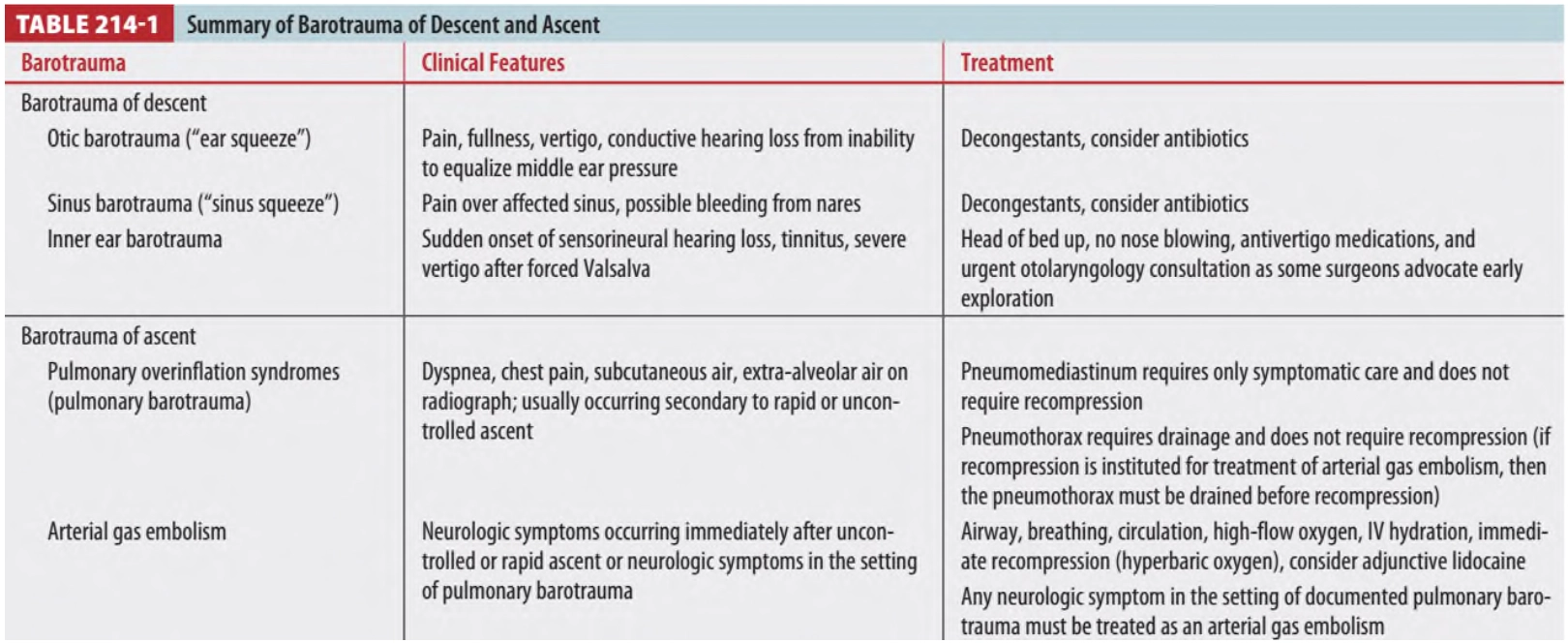
Barotrauma of descent
b.
Barotrauma of ascent
c.
Decompression sickness
d.
Immersion pulmonary edema
e.
Oxygen toxicity
f.
Nitrogen narcosis
•
The gas laws
보일의 법칙 : 온도가 일정할 때 기체의 압력과 부피는 반비례
달톤의 법칙 : 혼합기체의 압력 = 각각 구성성분의 압력의 합
헨리의 법칙 : 기체의 용해도는 압력에 비례
B. Barotrauma of descent
B1. Pathophysiology
•
Air-containing body cavities의 기체 부피가 감소함으로써 생긴다
•
기체 부피 감소로 tympanic membrane이 안으로 구부러지며 귀에 pain 및 fullness를 유발시키게 된다.
•
Valsalva를 통해 유스타키오관에 공기를 가하는 것이 중이와 외이도의 압력 평형을 맞추어줄 수 있다
를 통해 유스타키오관에 공기를 가하는 것이 중이와 외이도의 압력 평형을 맞추어줄 수 있다 (Equlizing)
•
Diver가 내려가면서 ear pain을 느끼면 equlizing을 시도, 실패 시 위로 상승하면서 압력을 줄이면서
다시 equlizing을 시도할수 있다.
•
Diver가 equlizing을 실패하면서도 계속 하강 시에 지속되는 통증 및 고막의 손상이 발생
—> Barotitis (ear squeeze)
B2. Barotitis (ear squeeze)
(1) 증상 : 이경 검사상 특이 소견 없이도 보이는 pain 및 fullness의 증상에서부터 고막 및 중이의 출혈 등 까지
(2) 임상적 특징
: Calorically induced vertigo, potential panic, drowning 및 이외의 손상이 원인이 된다.
(3) 치료
•
Conservative Tx. (with analgesics-진통제, decongestants-충혈제거제)
•
고막 파열 : 항생제 치료 시행
B3. External ear squeeze
(1) Pathophysiologiy
: 귀지나 귀마개 등으로 인해 external canal이 막혔을 때 외이와 고막 사이의 압력을 맞추지 못해 생기며 고막이 바깥으로 구부러지면서 손상을 발생시킨다
(2) 증상 : Pain, Tympanic membrain hemorrhage
B4. Sinus barotrauma
(1) 원인
Sinus의 구멍 이 막힐 경우 압력이 증가함에도 공기가 sinus로 들어가지 못해서 발생함
(2) 임상증상
•
Pain
•
Mucosal edema
•
Submucosal hemorrhage and stripping of the sinus mucosa from bone, hemorrhage
드물게 paresthesias in the infraorbital nerve distribution까지 이를 수 있다
(3) 치료 : 보존적 치료 (Decongestants - 충혈제거제, 항생제 치료 고려)
B5. Inner ear barotrauma
(1) Pathophysiology
•
Valsalva maneuver(to equalize the middle ear pressure)을 강하게 시도할 시 cerebrospinal fluid 사이의 압력차이가 vestibular & cochlear structure과 middle ear air space를 통해 전달됨 .
: 이것이 : rupture of the oval or round window fistulization of the window, tearing of the vestibular membrane및 복합 손상을 유발함.
•
이러한 상황에서 Eustachian tube을 열었을 시 중이의 압력이 급격하게 증가하고 이러한 변화가 내이에까지 전해져 손상을 발생시킨다.
(2) 임상 증상
•
Unilateral roaring tinnitus
•
Sensorineural hearing loss
•
Profound vertigo
•
Fistula test - Positive
손상된 쪽의 고막에 공기를 불어넣으면 눈동자가 손상된 반대쪽으로 돌아감
•
Vestibular decompression sickness, cerebral arterial gas embolism, or alternobaric vertigo로
인한 vertigo와 감별점
→ Inner ear barotrauma 는 하강 시에 발생 + Valsalva maneuver를 강하게 시도하다 발생하기
때문에 hx 상 “equlizing 하는 것이 힘들고 잘 되지 않음“ 에서 다른 원인들과 감별할 수 있다
(3) Inner ear barotrauma의 합병증
•
Drowning : Potential panic or disorientation으로 인해서
•
Pulmonary barotrauma : pain or panic으로 갑자기 상승하면서 발생함
(4) 치료 : controversial 함
•
Immediate exploration을 추천하는 사람도 있고
•
Bed rest (head upright)를 추천하는 사람도 있음
•
Vertigo 조절 약제
•
CSF 압력상승을 줄이는 방법 (e.g., stool softeners, 코 세게 풀지 않기)
•
Reserve exploration
: 보존적 치료에 반응이 없는 환자나 심한 청력 손상이 동반된 환자,
: Oculo-nystagmogram에 의미 있는 이상 소견을 보이는 환자
•
Emergent tympanostomy
: Hyperbaric oxygen treatment를 시행해야 하는 환자
(Inner ear barotrauma 가능성이 있는 환자에서 decompression sickness or cerebral arterial gas
embolism를 치료하기 위하여 hyperbaric Oxygen tx. 를 시행할 경우 perilymph leakage가 늘거나 다른 손상이 더 심해질 수 있기 때문에)
B6. Face squeeze, tooth squeeze, and dry-suit squeeze
(1) Face squeeze
•
Descent 시 수압이 올라가며 mask가 collapse 되면서 얼굴, 눈에 손상을 일으키면서 발생
•
얼굴 멍, 결막충혈/출혈, 시력변화, 드물지만 retrobulbar hemorrhage 발생시킴
(2) A tooth squeeze
: 치아 안의 air space(decay, a filling, or an abscess)가 compression 되면서 발생
C. Barotrauma of ascent
C1. Alternobaric vertigo
(1) Pathophysiology
시 가 내려가며 공기가 팽창한다 Ascent Pressure .
①
②
Ostia of the sinuses
로 공기들이 흘러가고 중이를 팽창시키고 이것이 유스타키오관을 열면서
이 공기들이 에 일시적으로 갇힌다 one middle ear cavity .
이로 인하여 압력차가 생기며 에 를 발생시켜 를 유발
