


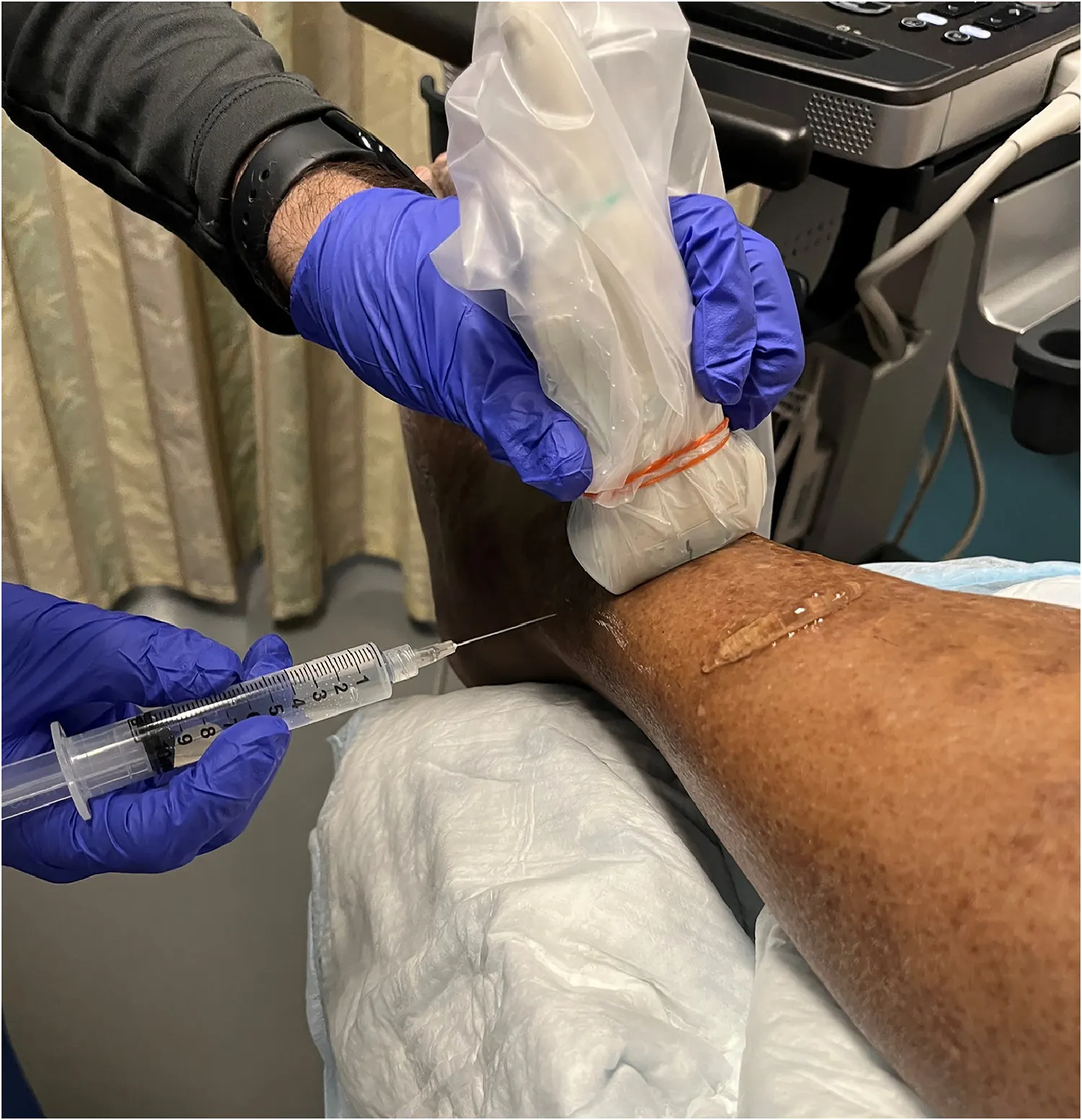
A superficial peroneal nerve block was performed under direct ultrasound guidance by our institution’s emergency medicine clinical ultrasound fellowship director, who had performed more than 100 ultrasound-guided regional anesthesia procedures. The patient was placed in the supine position with the left leg elevated on a towel roll to allow for an easier approach to the superficial peroneal nerve. The emergency medicine physician was positioned lateral to the patient’s left ankle with the ultrasound machine at the foot of the bed. Using a Mindray M-9 ultrasound machine (Shenzhen, China), a L4-12s high-frequency linear probe was positioned on the distal anterolateral aspect of the patient’s shin in transverse orientation to visualize the superficial peroneal nerve slightly lateral and superficial to the fibula (Figure 3). The nerve was initially visualized at the mid shin and followed distally to its most superficial position just proximal to the ankle where the block was performed.
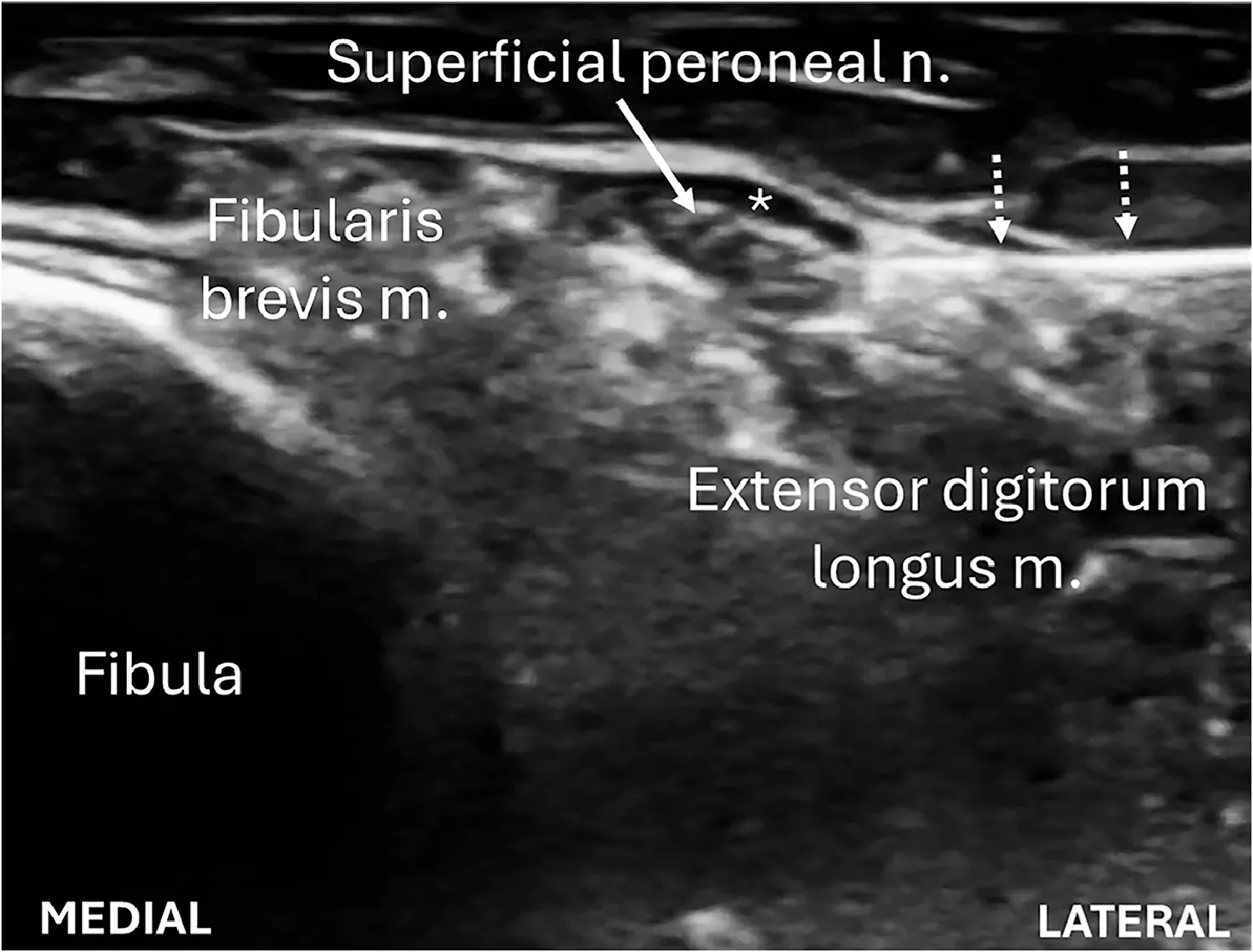
The patient’s skin was prepped with chlorhexidine, and with a sterile probe cover over the ultrasound probe, the superficial peroneal nerve was again identified. Under ultrasound guidance using an in-plane technique, a 27-gauge hypodermic needle was inserted in a lateral to medial direction. The needle pierced the surrounding superficial fascia and then the needle tip was positioned directly adjacent to the nerve, taking care not to injure the nerve (Figure 4). After aspirating to ensure the needle tip was not located intravascularly, 6 mL of ropivacaine 0.2% was injected around the nerve in a circumferential fashion (Video 1).
We describe what we believe to be the first reported use of the ultrasound-guided superficial peroneal nerve block in the ED to facilitate painless I&D of a subcutaneous hematoma on the dorsum of the foot without the need for any additional analgesics. This case demonstrates how the ultrasound-guided superficial peroneal nerve block may be an appropriate analgesia technique for I&D procedures on the anterolateral ankle and dorsum of the foot.
The superficial peroneal nerve is a terminal branch of the common peroneal nerve which travels down the lateral side of the leg.9 While it predominantly supplies cutaneous sensation to the anterolateral ankle and dorsum of the foot, the superficial peroneal nerve also provides some motor innervation to the muscles of the lateral compartment of the leg, which are responsible for eversion of the foot.10 Unlike blockade of the popliteal portion of the sciatic nerve or deep peroneal nerve which results in transient foot drop11,12, the motor blockade associated with a superficial peroneal nerve block is typically not clinically significant, making it an ideal regional anesthesia technique for superficial ED procedures of the anterolateral ankle and foot. Following blockade in our case, the patient was able to bear weight and ambulate without difficulty.
Anesthesiologists commonly use the superficial peroneal nerve block in conjunction with other ankle nerve blocks to provide anesthesia for foot surgeries and other procedures on the foot.12–14 Isolated blockade of the superficial peroneal nerve is uncommon in the perioperative setting due to its relatively limited motor and sensory distribution. This, however, makes it an ideal selective sensory nerve block for ED procedures involving the anterolateral ankle and dorsum of the forefoot. Several prior reports have described emergency physician-performed ultrasound-guided superficial peroneal blocks alone or in combination with other regional nerve blocks for reduction of ankle dislocation15, other ankle injuries16, and analgesia for painful snakebite envenomation.17,18
While ankle blocks, including the superficial peroneal nerve block, can be performed using landmark or ultrasound guidance, ultrasound-guided techniques tend to provide superior anesthesia since ultrasound allows for direct visualization of the nerves.19
In conclusion, the ultrasound-guided superficial peroneal nerve block may be an appropriate anesthetic tool to enable emergency physicians to perform painless superficial procedures on the anterolateral ankle and dorsum of the foot, including I&D of superficial skin hematomas.
Why should an emergency physician be aware of this?: The ultrasound-guided superficial peroneal nerve block may provide safe and effective anesthesia for minimally invasive ED procedures on the dorsum of the foot. Use of this nerve block technique in the ED may avoid the need for procedural sedation or higher doses of opioid analgesics, especially in elderly patients or those with certain cardiopulmonary comorbidities.
Video 1. Ultrasound-guided superficial peroneal nerve block. The needle is directed in a lateral to medial direction until it pierces the fascia surrounding the nerve. After aspiration, anesthetic is deposited in a circumferential fashion to surround the nerve.
